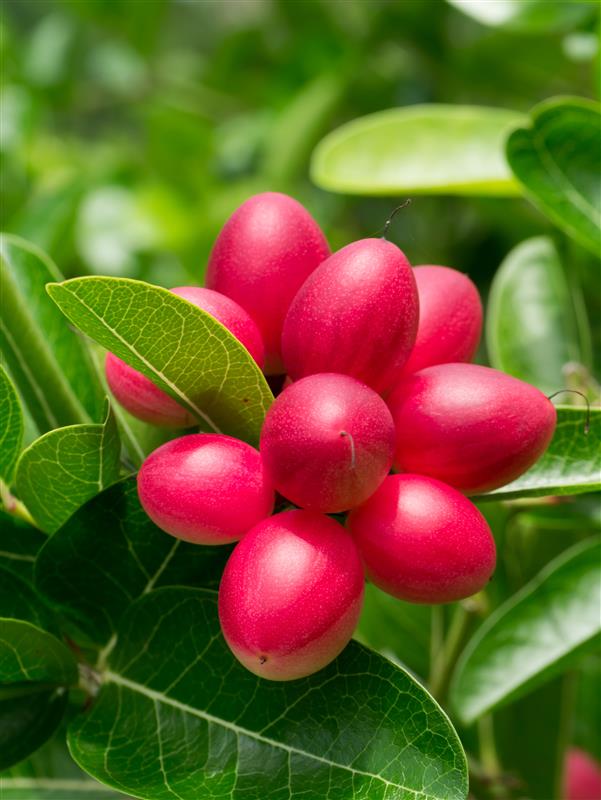
The berry has been used in West Africa for a long time. It is a part of the diet of the Yoruba people.[7] Others have used the fruit since at least the 18th century, when a European explorer, the Chevalier des Marchais, provided an account of its use. Des Marchais, who was searching West Africa for many different fruits in a 1725 excursion, noticed that local people picked the berry from shrubs and chewed it before meals.
In the 1980s in the United States, an attempt was made to commercialize the fruit for its ability to mask non-sweet foods as sweet without a caloric cost, but the Food and Drug Administration classified the berry as a food additive and required evidence of safety.[9][13][14] For a time in the 1970s, US dieters could purchase a pill form of miraculin.[15] This interest had a revival in food-tasting events at which tasters consume sour and bitter foods, such as lemons, radishes, pickles, hot sauce, and beer, then experience the perceived change to sweetness with miraculin.[16]
In tropical West Africa, where this species originates, the fruit pulp is used to sweeten palm wine.[21] Historically, it was also used to improve the flavor of soured cornbread,[8] but has been used as a sweetener and flavoring agent for diverse beverages and foods, such as beer, cocktails, vinegar, and pickles.[22]
Since 2011, the United States FDA has imposed a ban on importing Synsepalum dulcificum (specifying ‘miraculin’) from its origin in Taiwan, declaring it as an “illegal undeclared sweetener”. However the ban does not apply when it is imported from other countries.[23]
In 2021, the company Baïa Food Co. in Spain was granted permission to put Dried Miracle Berry on the market in the EU.[24]